

Be careful! Scammers are usurping the name of our leaders!
Many citizens report to us that they have received suspicious emails from leaders (or former leaders) of the Federal Police, or even from officials of other police or judicial institutions. This is a scam attempt executed via emails or through the creation of fake sites or fake news.

Modus operandi
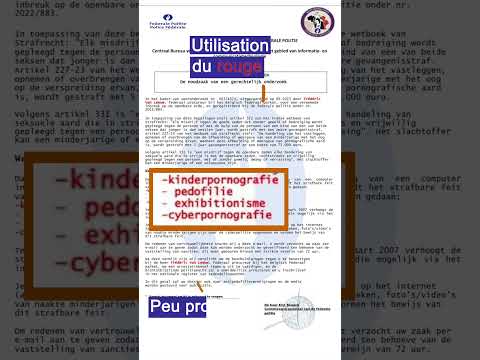
For several months, and on a recurring basis in recent weeks, individuals have been sending emails or letters to the attention of Catherine De Bolle, current director of Europol and former commissioner general of the Federal Police, or to other police authorities, reporting that they have received an email from a senior official of the "Brigade for the Protection of Minors", reporting an illegal consultation of (child)pornography sites and for which the payment of a "fine" is proposed instead of legal proceedings. Some of these people attach proof of payment or even a cheque to their letter. The names of the current commissioner general Eric Snoeck and the former commissioner, Marc De Mesmaeker, are used. Scammers also impersonate other police and judicial officials.
Some of the e-mails use the subject line "Your summons" and claim to inform you that you have committed various offences, or even sent photos of a sexual nature to minors. The sender says that you must pay a fine or you will be prosecuted. Unfortunately, people sometimes pay this so-called fine. Unfairly, because the money then goes directly to the fraudsters.
As this phenomenon affects all French-speaking countries, a consultation has been set up via Europol. More recently, we have noticed that messages are also appearing in Dutch. It is therefore possible that Flanders or even the Netherlands will be affected by the phenomenon.
Practical advice
The Federal Police reminds you of the precautionary measures in case of receiving a suspicious e-mail:
- The police will never send you a fine by email.
- Check the email sender's address: if it's fancy or strange (e.g. policefédérale@hsruhaw.com or federalpolice@gmail.com), there's a good chance it's a scam attempt. The police do not use a free email address in any way.
- Never reply to an email that seems surprising, or even suspicious.
- An email that contains spelling or grammatical errors, or is not written in a professional manner, is suspicious.
- Check the accuracy of the information received by searching the Internet for the existence of reports. Some sites such as www.hoax-net.be or www.signal-arnaques.com can enlighten you about the existence of a scam.
- Never give out your personal or banking details via phone or email at the request of a third party. Report fraudulent emails to the services in charge in one click via the Safe on Web website: https://www.safeonweb.be/en/
- Send a copy of the fraudulent email to the following address: suspect@safeonweb.be. Then delete the suspicious email.
Are you nevertheless the victim of a scam via a fake email?
- Notify your bank and CardStop as soon as possible in order to block any financial transactions that may still be blocked, and possibly your bank cards.
- Contact the Local Police to file a complaint.
- Change your passwords and possibly scan your computer with an antivirus if you think you have installed malware.
Want to know more?
- For more information on precautionary measures, we invite you to consult the website of the "Centre for Cybersecurity Belgium" (CCB) at the following address: https://www.safeonweb.be/ . You will also find valuable prevention advice. The Safe On Web app, downloadable from Google Play and Apple Store, allows you to receive real-time alerts on your mobile if the wifi network you are on is corrupted.
- In 2024, 9 million suspicious messages were sent to suspect@safeonweb.be, an average of 25,900 reports per day.
- National Security Plan 2022-2025 - The subject of this article is part of the fight against the phenomenon of hacking, computer sabotage, computer fraud and scams on the Internet


