

Avoid forest fires (prevention)
Source: Walloon Public Service - Environment
Summer is back, but so are heat waves and drought. The latter increases the risk of forest fires. Here is an article that will remind you of the actions not to take during your walks in our forests.

Currently, the Walloon Public Service does not have official statistics concerning its area of competence, but the National Forestry Office, in France, notes that 90% of fires in natural sites are due to human carelessness (discarded cigarettes, braziers, barbecues, work in the forest, glass bottles, etc.) where 30% of these departures are due to malice (arson). Natural causes that trigger fires are much rarer.
Agricultural or forestry work, transport and leisure, in contact with these natural spaces, contribute to the outbreak of forest fires. Also noteworthy is the case of electric arcs that can occur between a high-voltage line and vegetation growing nearby.
The main types of forest fires?
Fire professionals distinguish between three types of wildfires that can occur simultaneously:
- Ground fires burn organic matter in litter, humus or peatlands. Not very virulent, their spread speed is slow. However, this type of fire is very destructive because it attacks underground systems. It can incubate for a long time in depth, which makes it more difficult to extinguish it completely.
- Surface fires occur in the lower strata of vegetation, i.e. the upper part of the litter, the herbaceous stratum and the shrub stratum. The spread of this type of fire can be fast when it develops freely, and if the conditions (wind and relief) are favorable for the spread.
- The crown fires attack the upper part of the trees. They generally release large amounts of energy and their propagation speed is very high. They are all the more intense and difficult to control when the wind is strong and the fuel is dry.
The factors of the spread of a forest fire and the constraints of extinguishing...
A fire in a natural area can develop quickly and unpredictably during a dry period. Fighting it is difficult because the extinguishing water often has to be brought from elsewhere and the wind fanns the fire.
Experience shows that – compared to residential and industrial fires – firefighting in natural areas requires a different and larger operational response, which quickly exceeds the capacity of a local fire department and other response services.
Prevention rather than cure
Extreme heat, drought or wind can turn a simple spark into a fire. A poorly extinguished cigarette butt, a spark in a field or a garden... It doesn't take much to start a fire.
Here are some preventive instructions to fight against the risk of fire in our forests:
- It is strictly forbidden to make fires in the forest;
- Never throw cigarette butts, even out of your car window;
- Avoid parking a car in tall grass, which can catch fire when in contact with the exhaust pipe;
- Do not burn green waste within 25 m of a forest, and always have something to extinguish the fire (e.g. garden hose nearby), also respect the municipal and provincial regulations in this area(*);
- Be extra careful when working with tools that produce sparks or heat (e.g., grinder, heat gun);
- Be very careful with barbecues: place them away from any flammable vegetation and provide a means of extinguishing.
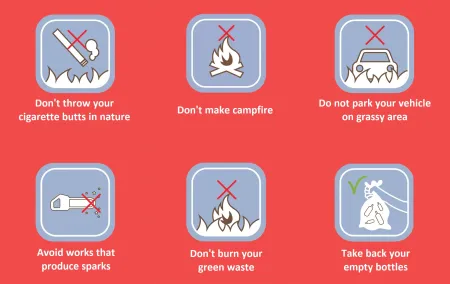
(*) Consult the bans in progress?
- Prohibitions may be decided locally by the Mayor or the Governor in the event of drought. They are published on the website of your municipality.
- The wallonie.be site keeps up to date with measurements during periods of drought
- Information panels are also installed in sensitive areas.
See a fire?
Are you dealing with a forest or brush fire? Stay calm and follow these steps:
- Call 112 to alert the emergency services. Give your position with precise landmarks (paths, parking lots, watchtowers) or, if you have access to them, your GPS coordinates (Longitude and latitude);
- Evacuate by following the existing paths and do not take any risks. Follow the instructions of firefighters and forestry officers;
- Alert people who may be in danger.
It doesn't just happen in the South of France, the Mediterranean countries or California
Forest fires, following the various heat waves, are also becoming a reality in our regions.
In 2023, no less than 170 hectares went up in smoke in the Fens, near the Belgian-German border. The fire was human-caused. (link to the press article)
In 2025, the cause of a fire in the Hoge Kempen National Park located in the province of Limburg was a villainous act. This forest fire had consumed "only" 50 hectares of vegetation. It was far under from the 8.3 million hectares burned during the forest fires in Canada the same year. (link to Canadian government website)
The last forest fire dates from Wednesday, July 9 and was taking place about twenty kilometers from SHAPE, in the Bonsecours state forest, on the French-Belgian border. (link to the article in La Voix du Nord, a French newspaper)
What does the Penal Code say?
Whatever happens, the fire department will determine whether the forest fire was accidental or not and the police will be required to carry out an investigation to determine the perpetrator. As our Penal Code is in the midst of change, we indicate to you, in a table, the main penalties incurred according to the old Penal Code (still applicable at the time of writing) and the new one which will be applied shortly.
| Old Penal Code | New Penal Code | |
|---|---|---|
| Arson |
Art. 511 10 to 15 years' imprisonment Art.513 (Done at night) 15 to 20 years |
Art. 505 (Fire) 6 months to 3 years imprisonment Art. 507 (Fire of a property of special interest) 3 to 5 years unless serious damage à 5 to 10 years Art. 508 (fire when the perpetrator should have presumed the presence of people on the scene) 10 to 15 years Art. 510 (Fire ignited during the night) 15 to 20 years |
| Unintentional fire |
Art. 519 8 days to 3 months + fine |
Art. 512 One of the following penalties:
|

